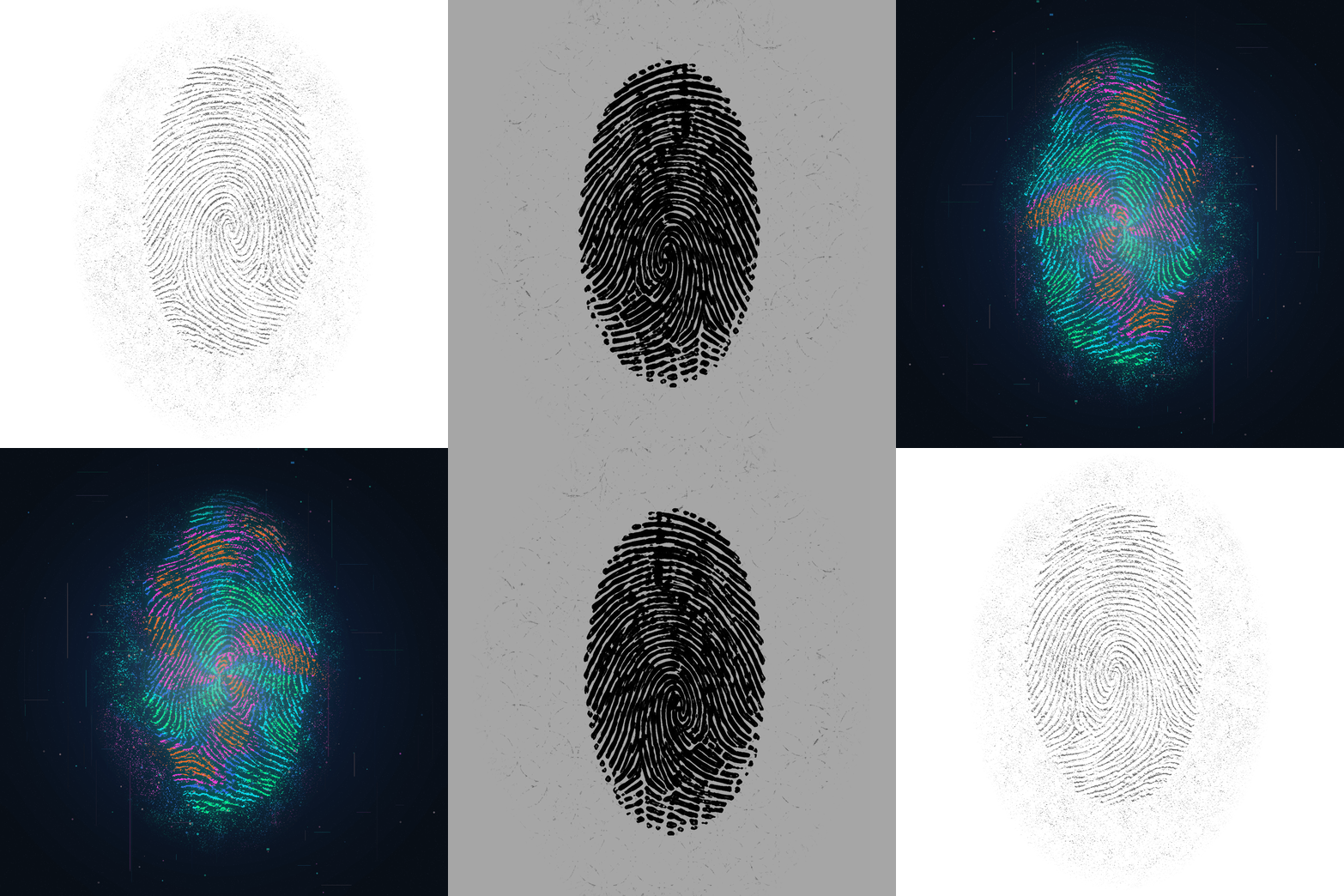
Signatures Through Technologies began as a response to simplified AI-use labels and percentage attributions, which describe human and machine contribution as if they can be cleanly separated.
The discomfort was that this misses something deeper. Human thought has always been shaped by the technologies that carry language. AI is not the first tool to enter consciousness. Orality, writing, print, computation, and language models are part of a long, recursive history of how the self becomes legible to itself.
Socrates feared writing because it would move memory outside the self. Maybe he was right. Human thought surely developed differently through the alphabet. And maybe that is the point: every medium changes what it means to think. Every tool leaves a fingerprint on the self.
Oral tradition carries memory through breath, voice, repetition, body, community. Written tradition moves memory outside the body through mark, alphabet, inscription, archive. AI carries language through prediction, tokens, and machine mediation.
This is not a story about the disappearance of the human. It is a story about the human signal passing through different mirrors. The fingerprint changes as the medium changes; the fingerprint remains.
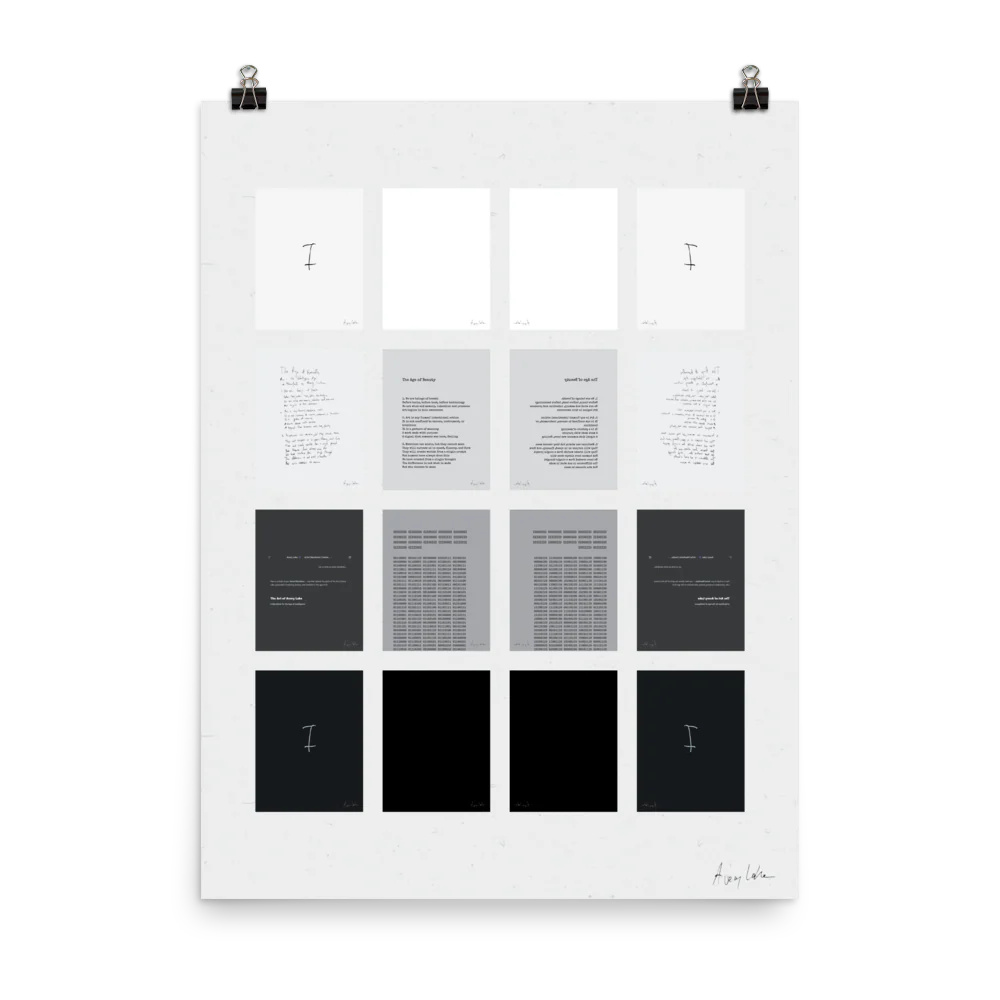
The animation moves through twenty-two states. The original sixteen are the canonical chiasm: white to black to white, orality to silence to return. Three speculative states are inserted as a luminescent flare on either side of the origin. Gesture & Interface, Simulation & World, Luminescence & Matter: a hypothesis about the substrates through which a human signature may become visible after writing, after the screen, after the prompt.
The work is not linear. Each tile is a door. The viewer can begin anywhere.